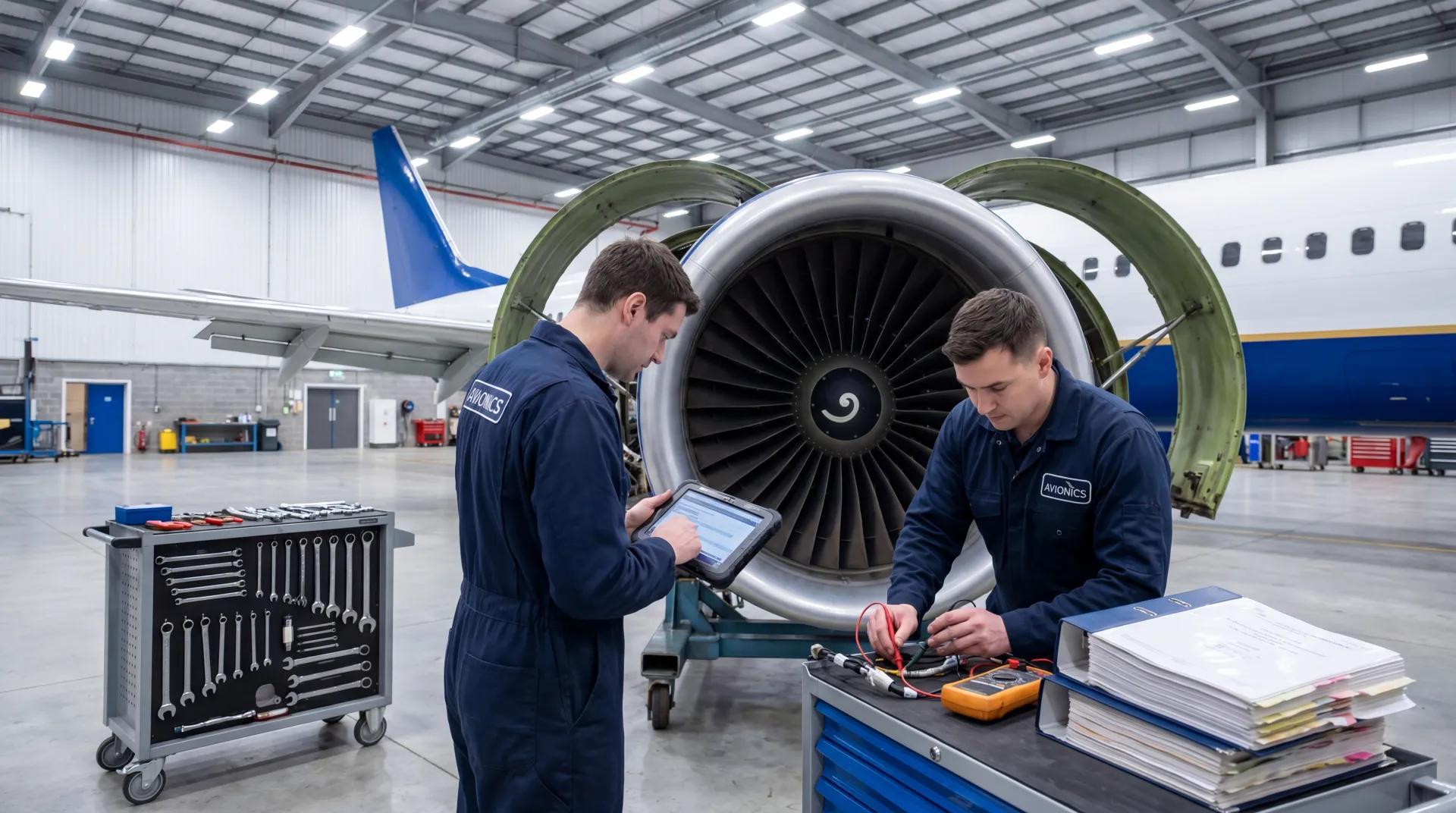
Workforce readiness assurance for environments where precision is the standard.
FAA-regulated maintenance, flight operations, defense manufacturing, avionics installation — every procedure has a specification, every specification has a tolerance, and every deviation has a consequence. AmpUp Insights verifies that your workforce can perform to spec, retains that capability over time, and produces the documentation to prove it.
Accelerate workforce readiness, engineering excellence, and operational performance through secure interactive learning, coaching, and simulation.
In aerospace, a missed procedure does not produce a defect. It grounds a fleet.
The margin for error in aerospace is defined by regulation, validated by inspection, and enforced by consequence. An incorrectly torqued fastener on a flight control surface. A missed inspection step in an engine overhaul. A wiring modification that does not conform to the approved data. Each of these is a maintenance discrepancy. Each of these can result in an airworthiness directive, a fleet-wide inspection mandate, or worse.
Your workforce knows this. Your maintenance directors know this. Your quality managers build their entire process around preventing exactly these failures. The gap is not in commitment. It is in verification. You can document that a technician completed the training. You cannot always document that the technician retained the knowledge six months later, or that a newly certified mechanic can perform the procedure to the same standard as someone with 20 years of experience.
AmpUp Insights closes that verification gap — not by adding more training, but by continuously measuring whether training produced the competency it was designed to produce.

FAA. AS9100. ITAR. The standards your workforce is already held to.
AmpUp Insights maps competency verification to the regulatory frameworks governing aerospace operations.
FAA Part 145
Repair station competency requirements for maintenance, preventive maintenance, and alteration. Verification that authorized personnel can perform the work they are authorized to perform.
AS9100 (Rev D)
Quality management system requirements for aviation, space, and defense organizations. Competency verification as part of the QMS human resources clause (Section 7.2).
ITAR
Training and awareness verification for personnel handling defense articles and technical data. Access control documentation for ITAR-controlled information.
DO-178C
Software quality assurance training for personnel involved in airborne systems development. Verification of understanding of the objectives and activities at each software level.
MIL-STD
Competency verification for personnel working on military programs with specific training mandates.
Each regulatory framework has specific competency requirements. AmpUp Learning does not treat them as a single compliance checkbox. Each framework has its own rubrics, its own verification criteria, and its own documentation format. The platform produces evidence structured for the specific standard the auditor is evaluating against.
Instrumentation. Operations. Maintenance. The full scope of aerospace competency.
Aerospace training is broader than regulatory compliance. AmpUp Learning covers the full scope of workforce competency across three domains.
Instrumentation & Avionics
Avionics systems training, navigation equipment familiarization, sensor calibration procedures, EFB operation, and cockpit systems orientation. Competency verification ensures that technicians and operators understand the systems they maintain and use -- not just the regulatory requirements around those systems.
Aircraft Operations
Flight crew CRM (crew resource management), type-specific operational procedures, operational limitations, emergency procedures, and abnormal operations. For operators and owners, this includes the operational knowledge required to safely use and manage the aircraft, not just the regulatory minimums for licensure.
Preparation & Maintenance
Pre-flight inspection procedures, scheduled maintenance task card completion, component overhaul procedures, NDT (non-destructive testing) technique verification, and return-to-service documentation. For maintenance organizations, this is the core of workforce competency -- can your technicians perform the procedures documented in the maintenance manual to the standards required by the type certificate holder?
From the sales floor to the hangar floor. One platform, every role.
Aerospace serves a value chain: manufacturers build the equipment, distributors sell it, installation shops install it, maintenance organizations maintain it, and owners operate it. Each link in that chain has training needs. AmpUp Insights serves all of them.
Business Development & Capture
You pursue contracts for avionics equipment, aircraft components, or maintenance services. Your customers are technical buyers -- maintenance directors, chief pilots, DOMs. They expect you to know the technical specifications, integration requirements, and certification status.
Installation & Distribution Shops
You install avionics, modify aircraft, or distribute aerospace components. Your technicians need to be current on installation procedures, service bulletins, and manufacturer-specific requirements.
Aircraft Owners & Operators
You own or operate aircraft. You need your flight crews trained on operational procedures and your maintenance staff current on the specific aircraft types in your fleet.
A&P Mechanics & Avionics Technicians
You perform the work. You hold the certifications. And you know that the gap between "passed the test" and "can perform the procedure from memory under time pressure" is real.
Quality Inspectors
You verify the work. Your role requires that you confirm maintenance was performed to standard, that documentation is complete, and that the technicians who performed the work were authorized and competent.
An AI agent that speaks your maintenance manual.
On the hangar floor, the Conversational Intelligence agent serves as a real-time reference engine for your organization's technical documentation.
“What's the torque spec for the left aileron hinge bolt on a King Air 350?”
Per the Beechcraft King Air 350 Structural Repair Manual, Chapter 57-10-01, the left aileron hinge bolt (P/N 101-524013-3) torque specification is 50-70 in-lbs, with Loctite 222 applied to threads. Inspect for free play after torque application.
Source: SRM Ch. 57-10-01, Rev. 34Structural Repair Manual
King Air 350 (B300)
Chapter 57 -- Wings
Section 57-10-01: Aileron
Revision 34 · 2024-11-15
- Torque specifications
- Wiring diagram references
- Inspection criteria
- Service bulletin status
- Parts & materials
Every query is logged. Every answer is sourced from your documentation. The agent does not improvise.
Workforce readiness for every team across A&D
From the engineering office to the hangar floor — competency verification for the teams that keep aircraft flying, programs on track, and supply chains resilient.
Engineering & Product Development
Accelerate knowledge transfer and consistent decision-making across complex programs.
Manufacturing & Production
Reinforce production processes, troubleshooting, and continuous improvement.
Program & Project Management
Strengthen decision-making, risk management, and stakeholder communication.
Maintenance, Repair & Overhaul
Develop technician expertise through realistic troubleshooting scenarios.
Quality & Compliance
Strengthen quality culture and ensure consistent application of standards.
Supply Chain & Procurement
Manage supplier relationships, mitigate disruptions, and navigate complex sourcing.
Customer Support & Field Service
Resolve issues efficiently while delivering consistent customer experience.
Business Development & Capture
Navigate long sales cycles, competitive pursuits, and customer engagements.
Related capabilities and use cases
Safety Certification
How AmpUp Insights produces documented proof that your workforce meets safety certification standards -- continuously, not annually.
Explore use case→Continuous Competency
The methodology behind spaced verification, retention measurement, and competency curves that show what your workforce actually knows over time.
Explore capabilities→Knowledge Retention
Certified two years ago -- can they still perform the procedure to spec? How spaced retrieval keeps procedural knowledge current.
Learn more→See what your training actually changed.
Schedule a briefing tailored to your operation and compliance requirements.