
Clinical competency verification that satisfies Joint Commission.
Continuous assessment, audit-ready documentation, and real-time clinical support — replacing annual skills day with verified competency curves.
The consequence of incompetence is a patient.
When the Joint Commission surveyor asks how you know your staff is competent, a binder of sign-off sheets is not an answer. Clinical competency requires continuous verification mapped to the regulatory frameworks that govern patient safety.
Who uses this
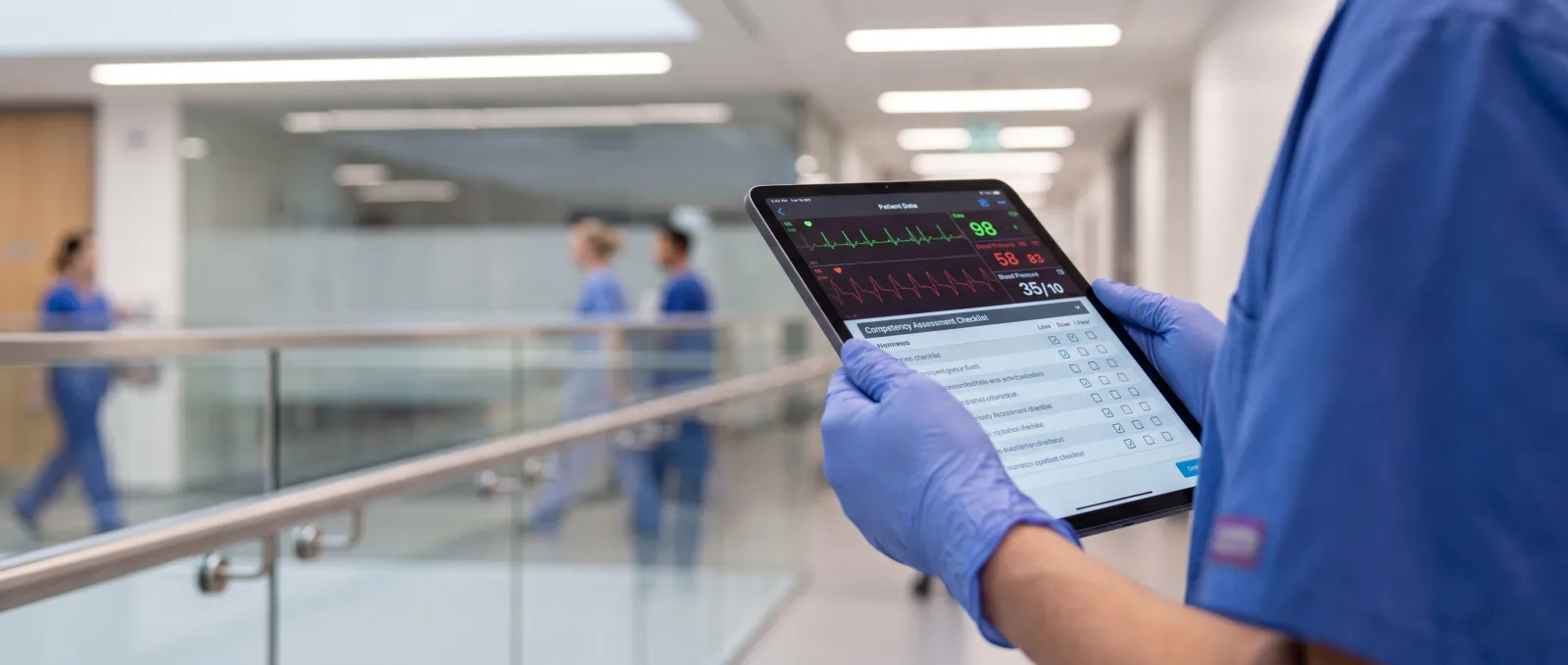
You build assessment rubrics mapped to Joint Commission standards. Instead of annual skills day, you run continuous competency checks and see exactly which protocols need reinforcement across your unit.
When the surveyor arrives, you pull timestamped competency data — not binders. Every assessment, every coaching interaction, every verification is documented and audit-ready.
You track real-time competency curves for your team. When a new protocol is introduced, you see who has demonstrated proficiency and who needs additional practice before they perform the procedure on a patient.
Your first month on the floor. Instead of shadowing until someone decides you are ready, your competency is measured against specific clinical criteria — and you get guided support when you need it.
A nurse on the floor can ask the AI agent about a specific protocol, drug interaction, or procedure — hands-free, in real time.
The AI agent references your clinical knowledge base, your SOPs, and your compliance frameworks to provide verified guidance exactly when clinical staff need it — not after the shift, not in a classroom, but at the point of care.
Learn about Conversational IntelligenceSee healthcare competency verification.
Book a demo tailored to clinical competency and Joint Commission requirements.